Pelp Care logo
Pelp Care

Connecting people who need help, with people who care

Pelp is care management software being built for UK social care, connecting digital care records, assessments, support plans and everyday communication around each Individual.

A support worker taking notes while checking an older woman’s blood pressure on a sofa at home

Care happens every day. Understanding it should be easier.

Good care depends on knowing the person, understanding their needs and recognising what matters to them.

But the information behind that care can become scattered across forms, documents, messages and different shifts. Important details are recorded, yet the bigger picture is often difficult to see. Pelp is designed to bring that information together, helping care professionals spend less time searching, repeating and piecing things together.

One connected platform. Three experiences.

Know the person. Understand the care. Keep everyone connected.

Concept image of the Pelp Staff app home screen on a phone, shown with sample data

Pelp Staff

Built for the people delivering care.

Record naturally

Care staff need documentation that fits around a working shift. Pelp Staff makes it easier to record everyday support, observations, activities and important events through clear, structured records, with optional AI assistance that staff can review before saving.

Explore Pelp Staff
Concept image of the Pelp Manager dashboard on a tablet, shown with sample data

Pelp Manager

A clearer view of your service.

Understand what needs attention

Managers need more than another dashboard filled with numbers. Pelp Manager brings together incidents, overdue reviews, assessments, care plans and outstanding actions, helping managers see where their attention is needed and follow the information back to its source.

Explore Pelp Manager
Concept image of the Pelp Family app on a phone, shown with sample data

Pelp Family

Meaningful updates, shared appropriately.

Keep the right people informed

Communication matters, but so does privacy. Pelp Family is being designed to help authorised family members, advocates and representatives receive appropriate updates and communicate securely with the care service.

Explore Pelp Family

From everyday records to a clearer picture of care

A care note should be more than something written and filed away. It can help explain a change, inform a review, show progress towards a goal or help the next person provide more thoughtful support. Pelp is designed to connect these pieces of information so they become easier to find, understand and use. See all features

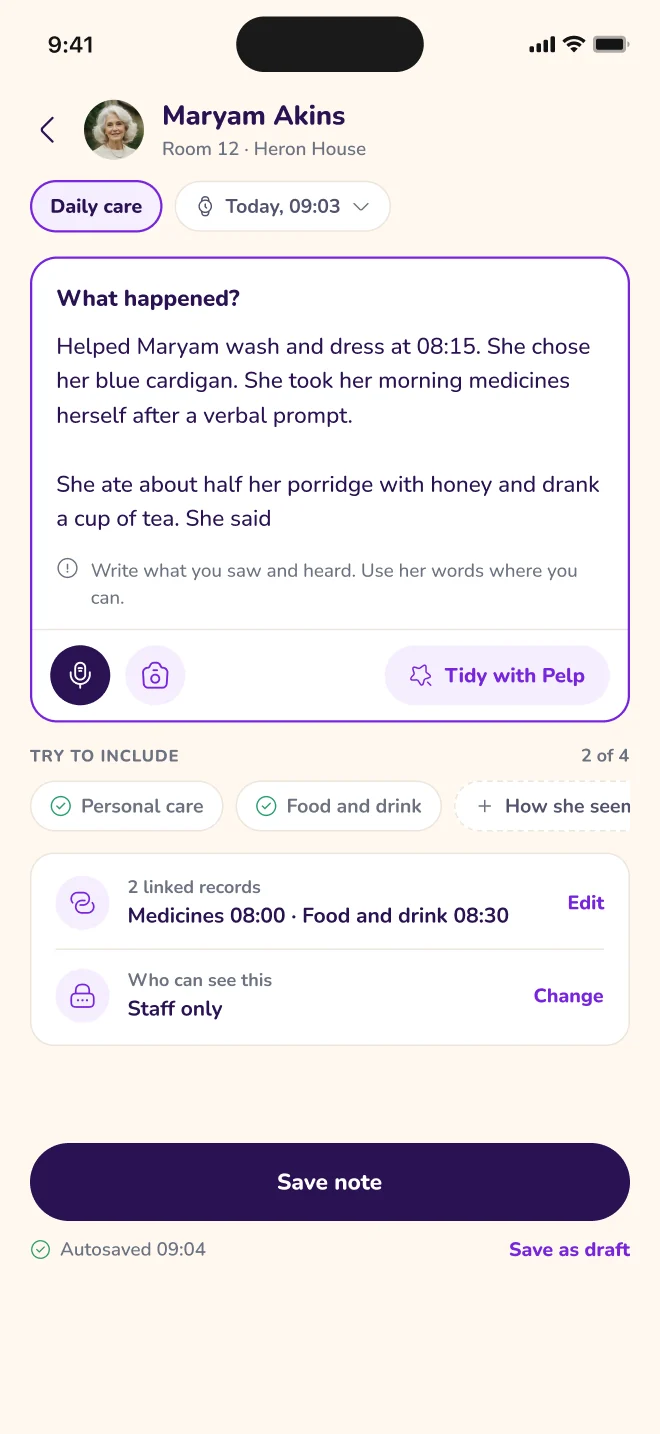
Capture everyday support clearly, with structured records, photographs, attachments, voice input and optional writing assistance.

Prototype design

Prototype flow with sample data: a support worker writes a daily care note, chooses Tidy with Pelp and reviews the draft, including a warning about an unfinished sentence and a list of what Pelp changed.

How Pelp brings care information together

Technology should support judgement, not replace it.

1

Record

Care staff capture everyday support, observations, activities, appointments and important events.

2

Connect

Pelp organises information around the Individual, linking records with plans, goals and care history.

3

Understand

Care teams and managers review information, explore patterns and see what may need a closer look.

4

Act with confidence

Professionals review the evidence, make decisions and update care through the right approvals.

Built for the realities of social care

Pelp is being developed with the everyday challenges of adult and children’s social care in mind. Whether support is provided in someone’s own home, a supported living service, a care home, a children’s home or within the community, the Individual should remain at the centre of how information is recorded and understood.

  • Supported living
  • Care homes
  • Domiciliary care
  • Children’s homes
  • Supported accommodation
  • Community support

Better information should help people deliver better support, without taking away the time, independence and relationships that make care meaningful.

AI, right where you need it

Care involves judgement, context, trust and human relationships. Artificial intelligence can help organise information, prepare drafts and draw attention to patterns worth reviewing. It cannot replace knowing the Individual or taking professional responsibility for their care.

Pelp highlights. Professionals review and decide.

About Pelp Intelligence

Prototype design of Pelp Intelligence with sample data. A manager asks which Individuals have changes that need reviewing. Pelp lists three changes from usual patterns, each linked to its source records, and states that it has not assessed risk. The manager then records their own review, outcome and follow-up actions.

Guides

Notes on care technology and everyday practice

Practical reading for Registered Managers and care teams choosing software, improving records and preparing evidence in UK social care.

Early access

Help shape what
comes next.

Pelp is currently in development, and we are inviting people working across adult and children’s social care to follow our progress and help shape what we build.

Join the early access list for development updates, product previews and opportunities to take part in feedback and future pilot discussions.

Built around people. Designed for care.

Join early access

We use your details to manage your early access request, as described in our Privacy Notice.

Frequently asked questions

Pelp is care management software in development for UK adult and children’s social care. It is designed to connect digital care records, assessments, care plans, incidents and approved family updates around each Individual, so staff, managers and authorised contacts can work from clearer information.

Care management software, sometimes called a digital social care record or DSCR, helps care providers record everyday support, keep care plans and risks up to date, oversee a service and share approved information securely. Pelp is being built as that kind of platform for UK social care settings.

Pelp is being designed for adult and children’s social care, including supported living, care homes, domiciliary care, children’s homes, supported accommodation and community support services, with distinct experiences for staff, managers and authorised family members or representatives.

Yes. Pelp is being built for both adult and children’s social care. That includes children’s homes and supported accommodation, where recording, manager oversight and quality-of-care reviews need to sit alongside day-to-day support for young people.

Pelp is currently in development. You can join the early access list to receive updates and hear about future opportunities to try the platform.

Inspectors look for accurate, timely records that show how people are supported. Pelp is being designed so everyday care notes, plans, incidents and reviews connect around each Individual, and so managers can see what needs attention before anyone asks for a report. Software does not determine the quality of a service; professionals remain responsible for care quality and judgements.

No. Pelp’s AI capabilities are intended to support authorised professionals with information retrieval, documentation, summaries and evidence-based review. Professional decisions and approvals remain with the appropriate people.

Pelp is developing approaches to examining patterns in authorised care records. Any capability that identifies or forecasts potentially important changes will require appropriate evaluation and safeguards before being made available for operational use.

No. Pelp Family is intended to show only information appropriately authorised for sharing. Internal records, restricted information and professional discussions will not automatically become visible.

Pelp is being designed to support connected care workflows. Options for importing information and integrating with existing systems are part of the development roadmap, but specific integrations will depend on technical availability and appropriate agreements.